
When and Why to Use
Use this to ask binary forced-choice questions across multiple comparisons. It's ideal for:
- Preference testing between paired items
- Quick-fire brand or concept comparisons
- Engaging users with fast-paced choice tasks
Supports randomization and media-based comparisons.
Other Names and Formats
A This or That Question with two options per row is a pairwise comparison, paired comparison, paired preference question, head-to-head comparison, or binary forced-choice question. Respondents choose one option from each pair.
Pair Groups
Pass a dictionary to row_options to place whole comparison pairs under non-selectable group headings. Defaults and returned answers keep the same row1, row2 and subsequent IDs assigned from the authored pair order. See Choice and Grid Groups for syntax and randomization rules.
Chat Experience
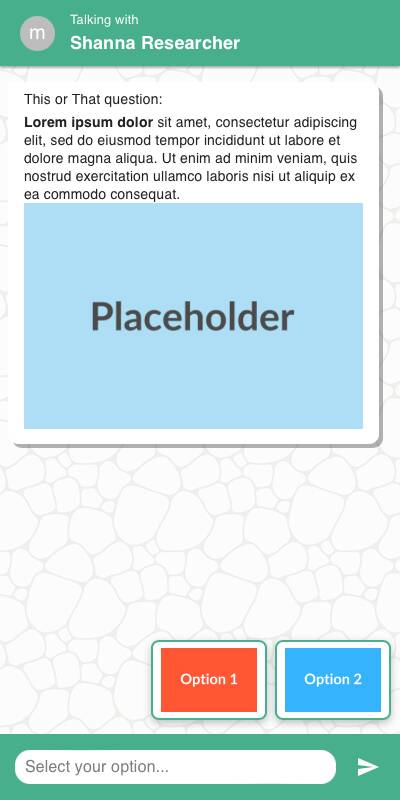
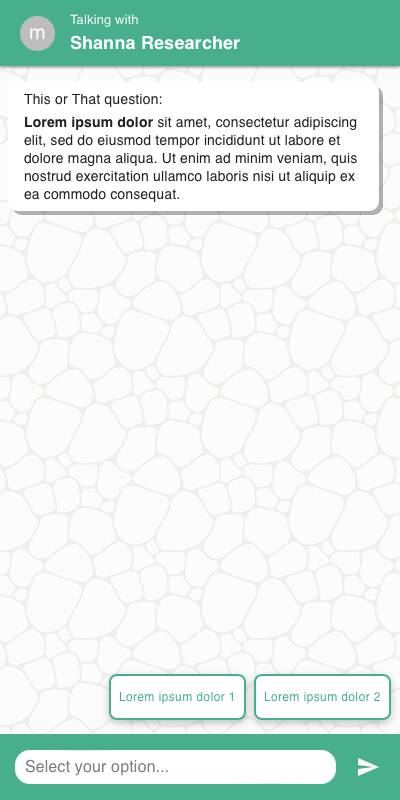
- Each pair appears as a row with two side-by-side buttons or tiles
- Users select one item at a time
| With images | Without images |
|---|---|
 |  |
Traditional Experience
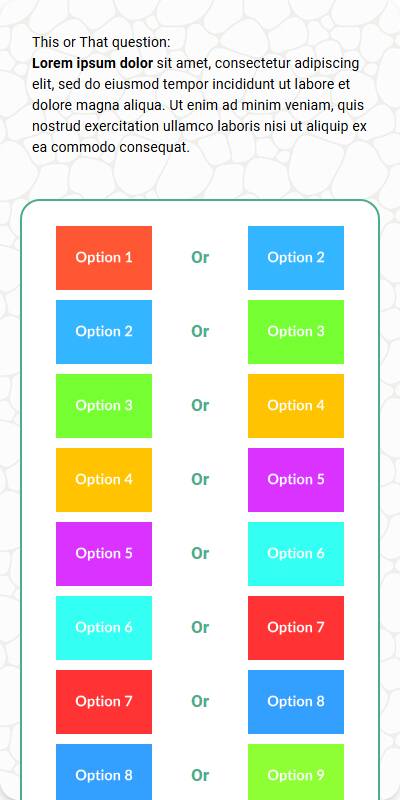
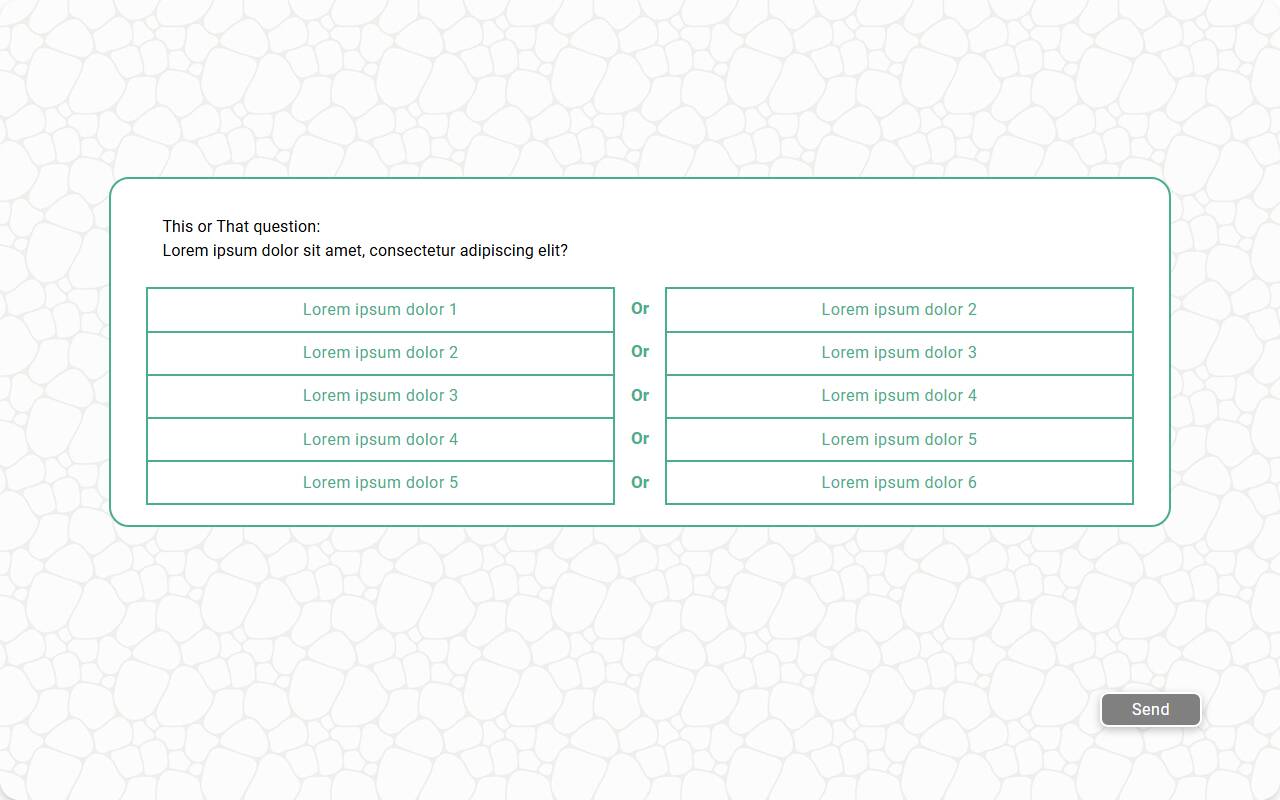
- All pairs displayed in grid format
- Responsive to keyboard or remote selection
- Layout adapts to show multiple pairs simultaneously
| With images, mobile optimized | Without images |
|---|---|
 |  |
Explicit Don't know response
Set dont_know_option="Don't know" for a separate choice in each pair. Its label must be distinct from the row's ordinary options. The response keeps the generated row ID and stores the configured label for an opted-out row. Respondents can switch back to either ordinary option without changing another pair.
Configuration Options
| Option | Type | Required | Default | Description |
|---|---|---|---|---|
dont_know_option | str | no | '' | Optional explicit opt-out label; per row for grids, otherwise for the whole question |
question | string | yes | - | The main prompt for the task |
row_options | List[List[str | MediaItem]] | Dict[str, List[List[str | MediaItem]]] | yes | - | Pairs as a flat list or groups under display headings |
randomize | bool | no | False | Shuffle the order of rows |
randomize_columns | bool | no | False | Shuffle left/right order within each pair |
default | Dict[str, str | List[str]] | List[Dict] | no | random choices | Default test responses keyed by generated row ID (row1, row2, ...); a per-row list supplies candidates; or a list of candidate dictionaries — each simulated respondent picks one at random |
recodes | Dict[str, str] | no | - | Map each exact selected option string to a reported value |
image | MediaItem | no | - | Top-level image shown above the task |
image_label_field | str | no | - | Media field used as the label for image options |
show_image_label | bool | no | True | Whether to show labels on image tiles |
image_size | Tuple[int, int] | no | (600, 600) | Size of displayed images |
custom_validator | Callable[[dict[str, str]], str | None] | no | - | Called with the complete parsed grid in both chat and traditional experiences. Return an error message to reject the response, or None to accept. |
number_seconds | int | no | 0 | Seconds to wait before allowing the respondent to continue |
tags | s.tag() | no | - | Used for token substitution and reporting |
id | str | no | - | Optional stable identifier for this question |
Example Code
s.this_or_that_question( "Which of the following do you prefer?", row_options=[ ["Apples", "Oranges"], ["Coke", "Pepsi"], ["Dogs", "Cats"], ["Winter", "Summer"] ] )
With recodes:
s.this_or_that_question( "Which of the following do you prefer?", row_options=[["Netflix", "Disney+"], ["Prime", "Apple TV"]], recodes={ "Netflix": "streaming", "Disney+": "streaming", "Prime": "ecommerce", "Apple TV": "streaming" } )
With custom validator:
s.this_or_that_question( "Choose your favorite in each pair", row_options=[["Day", "Night"], ["Hot", "Cold"]], custom_validator=lambda d: "Please vary your responses" if len(dict.fromkeys(d.values())) == 1 else None )
Notes
- Returns a
DictResponseofStringResponsevalues keyed by generated row ID — one-based (row1,row2, ...) in both chat and traditional experiences - Defaults always use the one-based keys (
row1,row2, ...), in both experiences - Each
row_optionsentry typically contains the two items being compared; rows with more options are allowed, and the respondent still selects one option per row - Randomizing column order helps reduce left/right bias
recodessimplify grouped reporting or segmentation, and map exact option strings only — numeric ranges and percentage keys are not supported- Use
custom_validatorto enforce answer patterns or detect straight-lining